


Consensus and SciSpace solve different research tasks. Use Consensus to ask a clear question and see what published studies suggest.
Use SciSpace to find papers, read dense PDFs, and explain hard sections.
Choose the tool that fits your next step.
Use Consensus for a quick read of research papers on one claim. Use SciSpace to find and read papers. Once you choose the papers to keep, use Atlas to compare them and open the passage behind each answer.

Synthesize selected papers in Atlas
Bring your selected papers together for cited synthesis you can inspect.
Quick verdict
Choose Consensus to ask, "What do studies suggest?" Choose SciSpace to ask, "What does this paper mean?"
Use both when you first need a quick answer and then need to read the papers behind it. Consensus works well for yes-or-no questions about a treatment, link, or claim. Check the cited text before you rely on the answer.
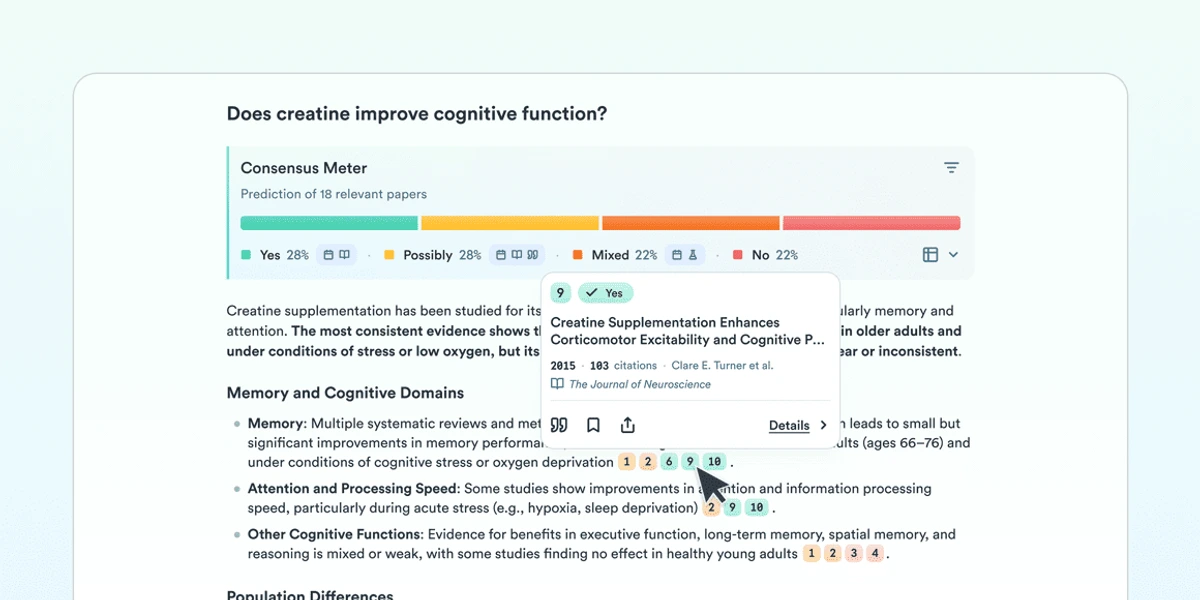
The Consensus research database searches published papers. Its Consensus Meter groups papers into yes, maybe, mixed, and no views for one question. The paper markers let you open the studies behind each group. This suits a claim check better than reading a dense PDF.
SciSpace covers more of the reading process. SciSpace, Literature Review, and Chat PDF help you search for papers, plan a review, and read PDFs. Both tools can be wrong. Open the cited paper, check the passage, and record why you kept or rejected each study.
Compare by question type
Start with the type of question. Finding papers, reading a PDF, checking a claim, and comparing a final set are separate tasks.
| Question type | Best first workflow | Why |
|---|---|---|
| What do my selected papers agree on? | Atlas | The task starts after paper selection and needs cited synthesis across a controlled source set. |
| Does the evidence support this claim? | Consensus | The task needs a research-paper answer and a fast read on evidence direction. |
| What papers should I read next? | SciSpace | The task is broader discovery beyond a claim check. |
| What does this dense paper mean? | SciSpace | The task is paper-level comprehension, section explanation, and PDF reading. |
| Which studies should enter my review? | SciSpace plus manual screening | The task needs search support and explicit screening rules. |
| Can I use this claim in writing? | Original papers plus citation inspection | The task needs source checking before an AI summary can be trusted. |
Table 1: Consensus gives a quick view of what studies suggest. SciSpace helps with search and reading. Atlas compares the papers you decide to keep.
Consensus vs SciSpace compared
The table compares each tool by research task. You may use both tools in one project.
| Research job | Consensus | SciSpace | Verification step |
|---|---|---|---|
| Ask evidence questions | Strong fit for focused scholarly claims | Useful, but broader than evidence answers | Read the cited papers and check the methods |
| Understand one paper | Less focused on PDF walkthroughs | Stronger fit for paper explanation and Chat PDF work | Check the relevant section in the PDF |
| Explore a topic | Good for evidence direction | Good for paper discovery and topic exploration | Save the papers that match the scope |
| Literature review discovery | Useful starting point for claim-level direction | Useful broader surface for finding and organizing papers | Document screening rules before synthesis |
| Extract evidence | Useful if the answer surfaces relevant studies | Useful if the paper workspace exposes relevant passages | Build an evidence table from original sources |
| Writing handoff | Helpful for deciding whether a claim is plausible | Helpful for explaining papers before drafting | Verify every claim that enters a draft |
| Synthesis across selected sources | Useful before synthesis begins | Useful before final synthesis begins | Use Atlas for grounded comparison across the selected set |
Table 2: Choose Consensus first for a clear question about published studies. Choose SciSpace when you need to find, read, and understand papers over time.
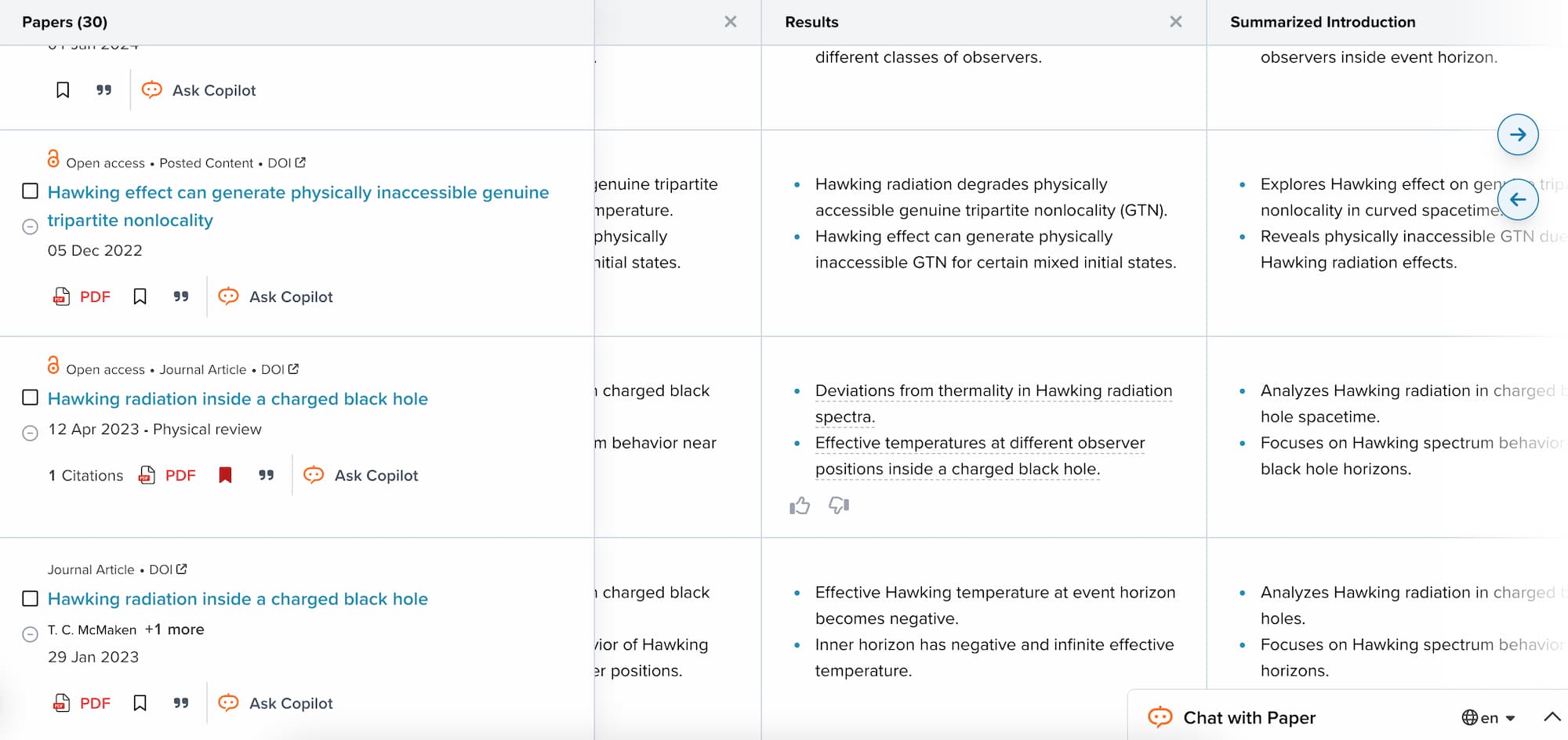
One product is not best for every step. In a literature review, Consensus can check a claim and SciSpace can help you read the papers. After you screen them, compare the final set in Atlas. Keep a clear path from each answer to the paper behind it.
Where Atlas fits after selection
After Consensus or SciSpace helps you find papers, add the ones you keep to Atlas. You control which papers, PDFs, notes, or web pages can support the answer.
Here is the concrete workflow.
- Save only papers that match your question and review rules.
- Add those papers or PDFs to one Atlas project.
- Ask, "Where do these studies agree and disagree on the outcome measure?"
- If the answer blends papers, ask for a table with the claim, source text, limit, and citation in separate columns.
- Open the citation on each claim you may use.
- Save only checked findings, along with the question and citations you read.
This keeps a small set of sources in one project and gives each answer a citation you can open. See AI citation analysis for a deeper source-check process.
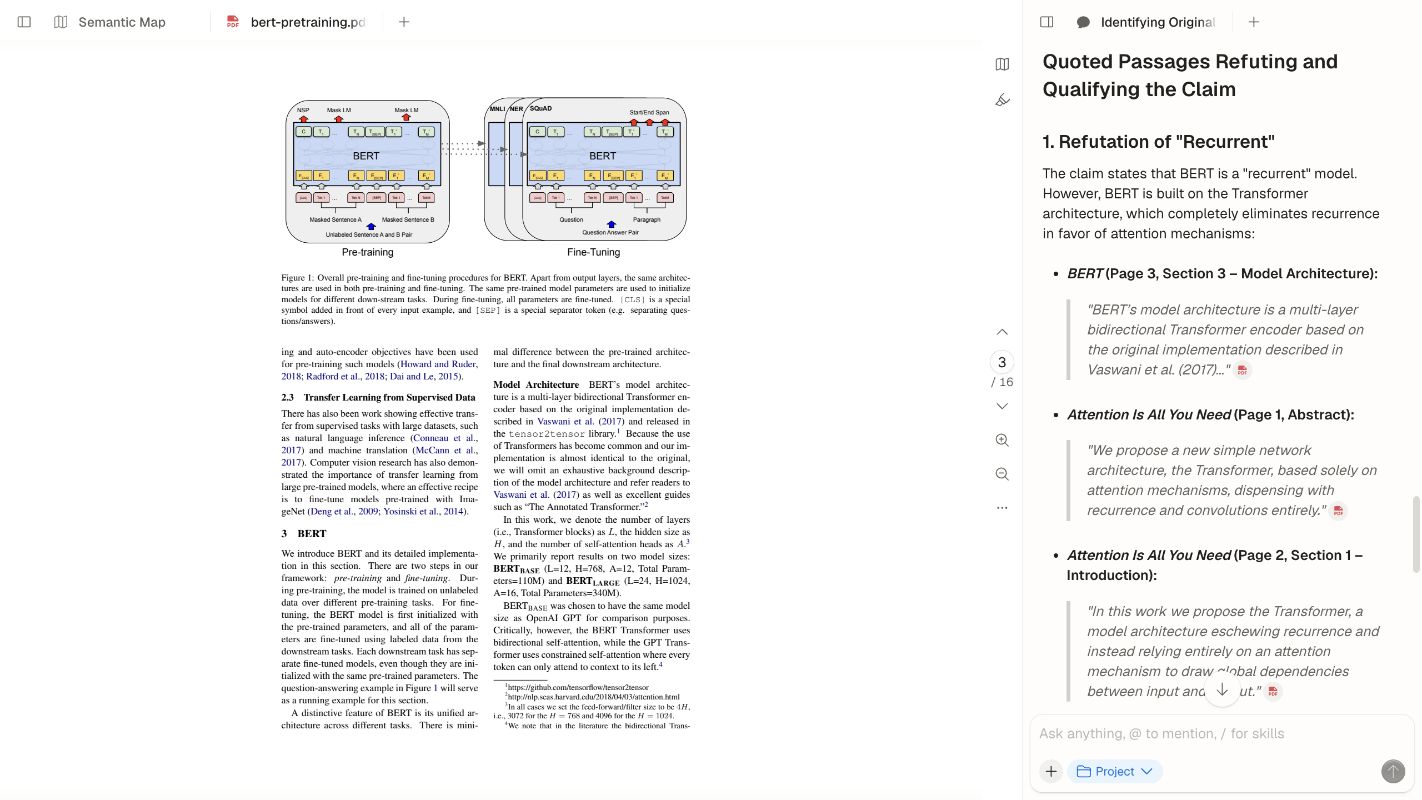
Suppose Consensus finds support for a study habit and SciSpace helps you read four of the papers. Add those PDFs to Atlas and ask which methods and limits repeat. Open the citation on each finding. If the passage supports only part of the answer, ask a narrower question.
Use Atlas when you know the paper set and need a study table, a list of gaps, or notes that keep sources apart. Trace every claim you reuse back to a paper rather than to an AI summary.
Which should you choose?
Choose Consensus for a quick answer from published studies. It suits questions such as "What do studies suggest?" and "Is there research support for this treatment or link?"
Choose SciSpace to work through papers. It helps you read dense PDFs, explore a topic, plan a literature review, and decide whether a paper belongs in your final set.
Use both when the task has two phases. Start with Consensus for a quick claim check, then use SciSpace to read possible papers. Screen them by hand, reject weak fits, and check the source text before you use the result.
Choose Atlas once you have a set of papers worth keeping. It can compare those papers and link each answer to the source text.
See also Scispace vs Elicit, Consensus vs Elicit, Consensus vs Perplexity, Elicit alternatives, and literature review software.
Synthesize selected papers in Atlas
Bring your selected papers together for cited synthesis you can inspect.