


Use Consensus when the answer should come from research papers, especially for evidence checks, yes or no paper questions, and claims that need a scholarly source set.
Use Perplexity when the search starts wider than papers. It works well for web research, fresh context, cited answers, and mixed-source projects. You can mix web pages, papers, social threads, files, and saved links.
The practical workflow is often a sequence: start in the tool that matches the source set, then move trusted papers, pages, reports, PDFs, or notes into Atlas. There, you can compare sources, check citations, and save a synthesis.

Compare selected sources in Atlas
Compare the papers and web sources you keep, then inspect citations.
Compare by source scope
Consensus is built around scholarly papers. Its research database documentation says it searches a large paper index. The index is updated weekly.
When full text is available through partners or open access, Consensus can use more than the abstract. That makes it a better first stop for the question, "What do papers say about this claim?"
The Consensus Meter goes further for yes or no questions. It sorts top papers into stances such as yes, no, maybe, or mixed. Consensus also warns that the meter is not all of science. It can miss nuance, sort a paper wrongly, and depend too much on the papers returned for the query.
Perplexity has a broader job. The Perplexity product hub presents it as a web search tool with citations and deeper research.
Its Projects documentation says you can group threads, files, custom instructions, and asset search in a workspace. Projects can pull from web search, papers, or social threads. They can also pull from files, paid data, and app links.
That range helps when the search starts messy. Think market scan, rule update, tech topic, industry analysis, or any task where fresh web context matters, but it fits less well when the source set must stay limited to papers from the start.
For adjacent paper-first comparisons, see Consensus vs SciSpace, Consensus vs Elicit, and Elicit in Elicit vs Perplexity. If the search starts from Perplexity instead, the reverse-order Perplexity vs Consensus comparison keeps the broad answer-engine job first.
Consensus vs Perplexity compared
This table keeps the comparison to workflow fit and skips plan limits and pricing. Prices and limits change fast, so check current docs before you buy.
| Decision point | Consensus | Perplexity | What to do next |
|---|---|---|---|
| Source universe | Peer-reviewed papers, with full-text analysis when available. | Open web, papers, social threads, uploaded files, and linked sources depending on mode and plan. | Choose Consensus for paper scope. Choose Perplexity for web-wide search. |
| Best question type | Evidence checks, especially yes/no claims that papers can support or weaken. | Broad research questions, fresh context, and fast cited answers that may need several source types. | Write the query around the evidence you need. |
| Citation behavior | Paper-level evidence and meter classifications can help you inspect which papers support each position. | Cited answers help you jump to web or project sources, but source quality varies with the query and retrieval. | Open the source behind any claim that will appear in a paper, memo, report, or decision. |
| Projects and files | Best understood as a paper search and analysis surface. | Projects can group threads, files, instructions, assets, and selected source types in one workspace. | Use Perplexity when mixed-source project work is part of the job. |
| Verification burden | You still need to read the papers, especially because meter classifications can miss nuance or classify imperfectly. | You still need to inspect citations, especially when sources include web pages, social threads, or fast-changing material. | Treat the AI answer as a navigation layer, then verify the passage or paper. |
| Best follow-up | Build a short reading list of the strongest papers and inspect disagreements. | Collect useful pages, papers, reports, and files from the broader search. | Add selected sources to Atlas when the next job is cited comparison, synthesis, or knowledge mapping. |
Table 1: The main takeaway is source scope. Consensus keeps the search closer to papers, while Perplexity opens the search to more source types. Pick the narrower tool when paper evidence matters, and pick the wider tool when context comes first.
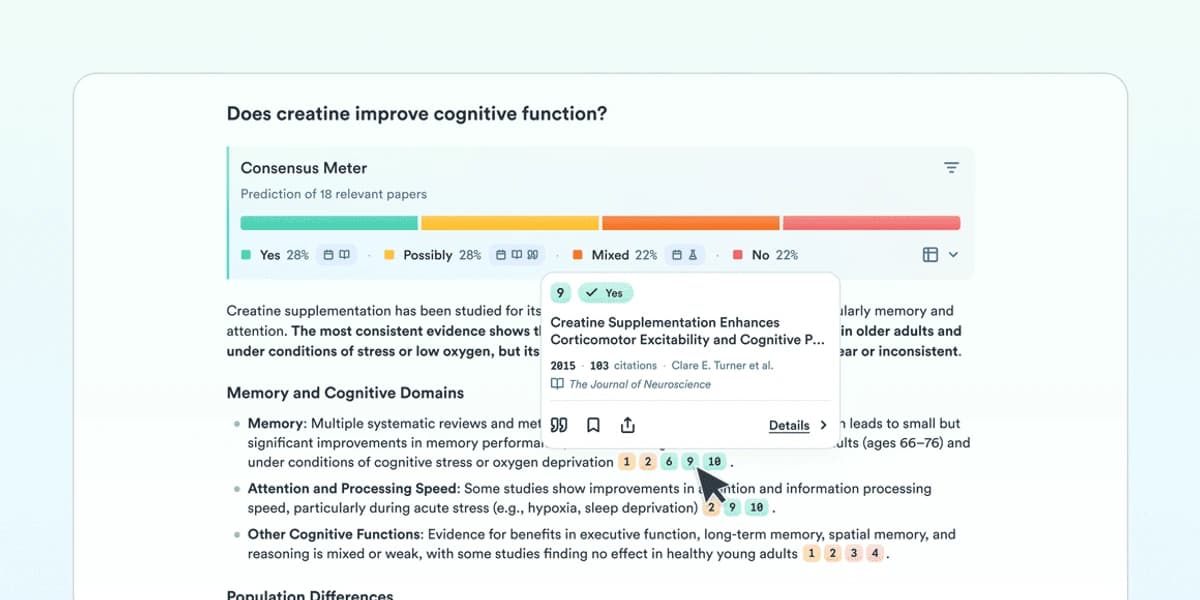
The Consensus screenshot matters for this comparison because it shows a paper-evidence surface rather than a broad answer engine. In text, the same evidence is compared as 18 relevant papers across yes, possibly, mixed, and no positions, then readers can open cited paper markers before they decide whether a claim needs deeper source review.
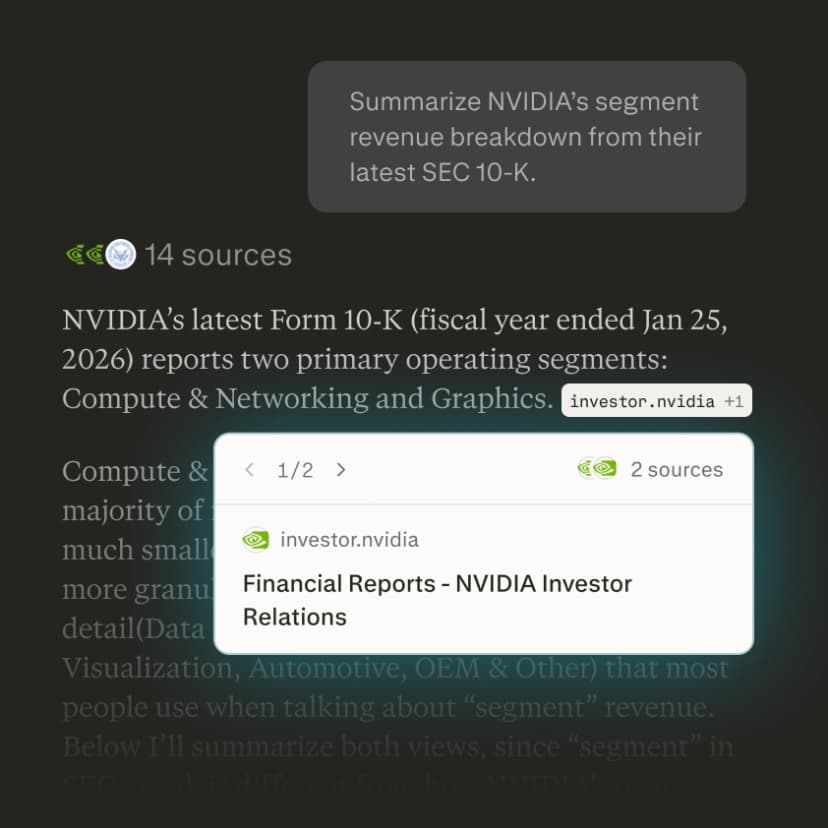
This official finance example shows how a Perplexity answer exposes a source card; it is product-interface evidence, not an academic research result. Product source.
If your comparison includes Atlas, read Atlas vs Perplexity for the source-grounded workspace angle. For a wider category view, use AI tools for academic research. If citation inspection is the deciding factor, the AI that cites sources guide explains what to check before reusing an answer.
For broader cited-answer comparisons, NotebookLM in NotebookLM vs Perplexity is useful when the source set is already collected, while ChatGPT in Perplexity vs ChatGPT Deep Research covers deeper open-web research workflows.
Where Atlas fits after discovery
Atlas belongs after the first search pass. Consensus can help find papers and show where a yes or no claim appears to lean, while Perplexity can help find fresh context and useful web sources. Atlas is useful once you have chosen the sources that should support the next claim.
Once Consensus or Perplexity narrows the set, Atlas is not another broad search. It is a source comparison workflow. Keep the chosen material in one project. Ask a grounded question across it. Open the source badges for the claims that matter. Use the map view when a dense source needs structure.
Atlas shows the kept source beside a cited answer and map so the handoff can move from discovery to source verification.
A source-grounded handoff can look like this:
- Use Consensus for the paper question. You might check whether papers support a claim.
- Use Perplexity for wider context. Look for explainers, regulations, organization pages, reports, or related terms.
- Keep only the sources worth close reading. That might be 5 papers from Consensus and 3 web or report sources from Perplexity.
- Add the chosen sources to Atlas.
- Ask a grounded question: "Where do these sources agree and disagree?"
- Open citation badges for key claims. Read the passages before you save the answer.
- Generate a knowledge map for a dense paper or report. Use it to see claims, methods, proof, and caveats together.
That handoff keeps each tool in its lane. Consensus and Perplexity help you find sources, while Atlas helps once you keep a source set and need grounded questions, source comparison, citation checks, and documented findings.
Which should you choose?
Choose Consensus when paper evidence comes first. It fits scientific, academic, or literature-centered questions, and it also helps with yes or no paper questions that can use the Consensus Meter. Read the contributing papers before you rely on the result.
Choose Perplexity if your first constraint is breadth. It fits current context, web research, project work, uploaded files, linked sources, and fast cited answers. Use it when you do not yet know which sources are worth keeping.
Use both if the topic has a paper base and a changing real-world context. For a public health topic, a student might use Consensus to find papers, then use Perplexity to read current guidance, policy debate, and recent news, but the final answer still needs source checks.
Use Atlas after either tool when the task shifts from finding sources to making a source-backed claim, because at that point source checks and synthesis matter more than another broad search.
Final workflow choice
Start with Consensus when paper evidence comes first, and start with Perplexity when you need broad, current, cited search. Neither removes the need to read the source behind an important claim.
If the output will become a literature review, memo, briefing note, client brief, or cited answer, split the task: find sources in Consensus or Perplexity, then compare the selected source set in Atlas before you reuse the answer.
Compare selected sources in Atlas
Compare the papers and web sources you keep, then inspect citations.