

Thesis AI tools split into two kinds. Some write thesis text for you. ThesisAI, which holds the top results for this search, turns your papers into a cited draft of 8 to 80 pages.
Others help you read your sources, cite them and write the thesis yourself. Atlas works that way. Jenni and Paperpal mostly do too, though Jenni's autocomplete suggests sentences and Paperpal also has a drafting tool. Most universities expect a thesis to be your own writing, so the second kind carries less risk as long as you write the sentences yourself.
Here are the picks, with prices taken from each vendor's pricing page on 7 November 2026.
- Atlas for reading and citing your sources. Ask one question across your papers and open the PDF page behind each claim.
- ThesisAI for a full cited draft, if your university allows AI-written text and you disclose it.
- Jenni for writing it yourself with cited autocomplete. Its free plan includes 10 autocompletes a day.
- Paperpal for editing, references and plagiarism checks before you submit.
- GoThesis for low-cost planning tools such as outlines and proposals.
Cite your thesis sources by page
Upload papers, ask one chapter question, and open the page behind each claim.
Thesis AI tools compared
The table shows what each tool does, whether it writes text for you, how it ties text to sources, and what it costs.
| Tool | Main job | Writes text for you? | Link to sources | Free plan | Billed monthly | Billed yearly |
|---|---|---|---|---|---|---|
| Atlas | Read and cite your papers | Writes notes with you | Opens the cited PDF page | 10 sources, 5 AI messages | $20 Plus, $40 Pro | $192 or $384 a year |
| ThesisAI | Full cited drafts | Yes, 8 to 80 pages | Reviews each sentence against your papers | None, paid trial only | $24 Basic, $32 Pro | $144 or $192 a year |
| Jenni | Write with cited autocomplete | Suggests text as you type | Links a sentence to its place in the PDF | 10 autocompletes a day | $30 Plus, $73 Pro | $144 or $348 a year |
| Paperpal | Edit and check before you submit | Mainly edits your text; also drafts | Finds references for your claims | 200 grammar edits a month | $25 Prime, $59 Pro | $144 or $348 a year |
| GoThesis | Plan the thesis | Outlines and writing blocks | Formats citations | 100 credits | $19.90 to $69.90 | $199 to $699 a year |
| Zotero (no AI) | Store and cite references | No | Cites inside Word and Google Docs | Free, 300 MB sync storage | No monthly plan | Storage from $20 a year |
Table 1: Prices in US dollars as shown to a visitor in Singapore on 7 November 2026. Regional prices and offers may differ.
How to judge a thesis AI tool
Five questions sort these tools quickly.
- Who writes the words? A tool that drafts chapters puts you closest to the line most universities draw. Tools that read, suggest or edit leave the writing with you.
- Can you check the page? A citation helps only if you can open the passage it rests on. Look for a tool that takes you to the place in the PDF. A reference list alone leaves you hunting.
- Does it work from your papers? Answers built from papers you chose are easier to check than answers from a model's memory. ThesisAI and Jenni both import from Zotero, the free reference manager in the last table row. Zotero has no AI, but it keeps your references in order whichever tool you pick.
- What do you get free? Free plans here range from none at all to a daily allowance.
- Which price are you looking at? ThesisAI's and Jenni's pricing pages open on the yearly plan, shown as a monthly rate. That rate is half the true monthly price or less. Google's AI Overview for this search quotes ThesisAI at $12 and $16 a month, which are those yearly rates. Check the billing toggle before you enter a card.
The 5 thesis AI tools
1. Atlas: cite sources by page
Atlas is a research workspace for the reading side of a thesis. You upload PDFs, or search for papers and paste DOI or arXiv links, and add them to a project. Then you ask questions across them.
Each answer carries numbered citations labeled with the file and page. Selecting one opens the PDF at that passage when Atlas has a precise location.
That fits the jobs thesis writers find hardest. You can find the page for a quote, keep a long reading list in one place, and build a synthesis across papers instead of a pile of summaries.
Atlas also writes and edits notes with you and exports them to PDF, Word or Markdown. Citation styles and BibTeX come with paid plans.
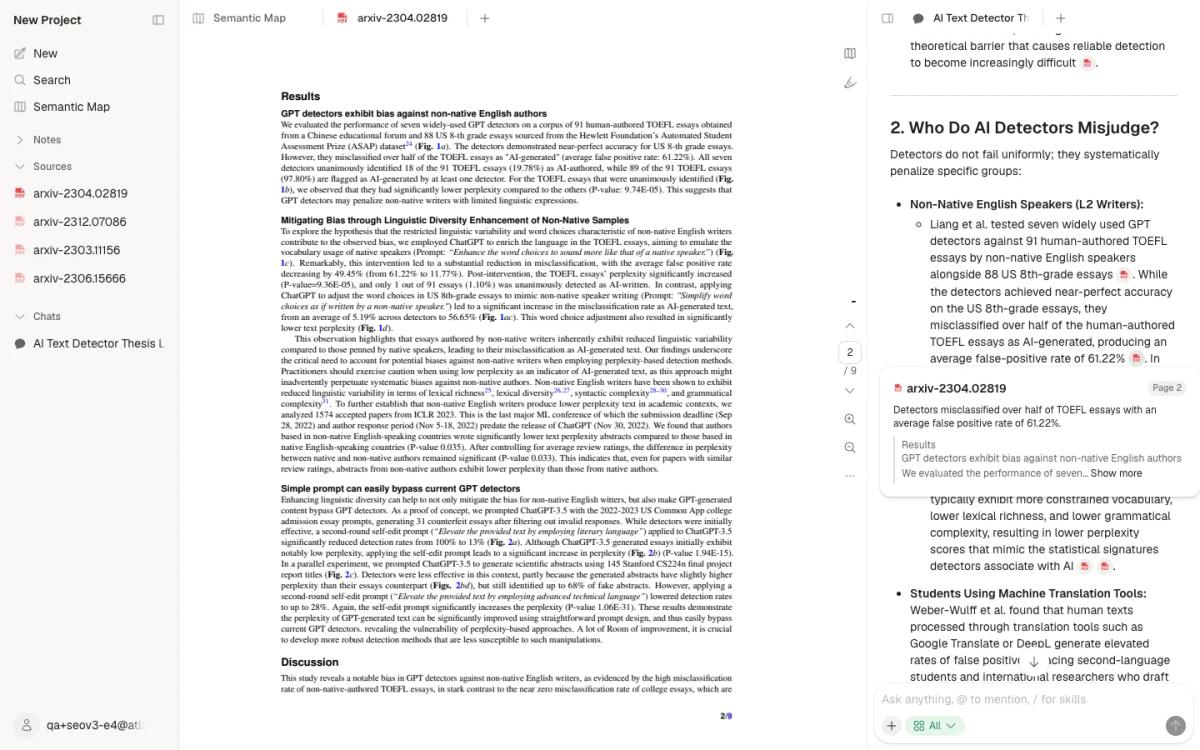
The hover card names the file, arxiv-2304.02819, and page 2. Below it sits the passage behind the claim that detectors misjudged TOEFL essays at a 61.22% average false positive rate.
Free gives you 10 sources and 5 AI messages, enough to test it on one chapter. Plus is $20 a month or $192 a year, and Pro is $40 a month or $384 a year, as listed on Atlas plans.
If you want a long draft written for you, ThesisAI is built for that job. If you want sentence suggestions while you type, Jenni is.
2. ThesisAI: full cited drafts
ThesisAI writes academic drafts of 8 to 80 pages from sources you give it. You can upload or import up to 500 papers, pull them from Zotero or Mendeley, or search Semantic Scholar.
It then reviews each sentence of the draft against those sources. Drafts export to PDF, LaTeX and BibTeX, with Word on Pro, and can go to Overleaf.
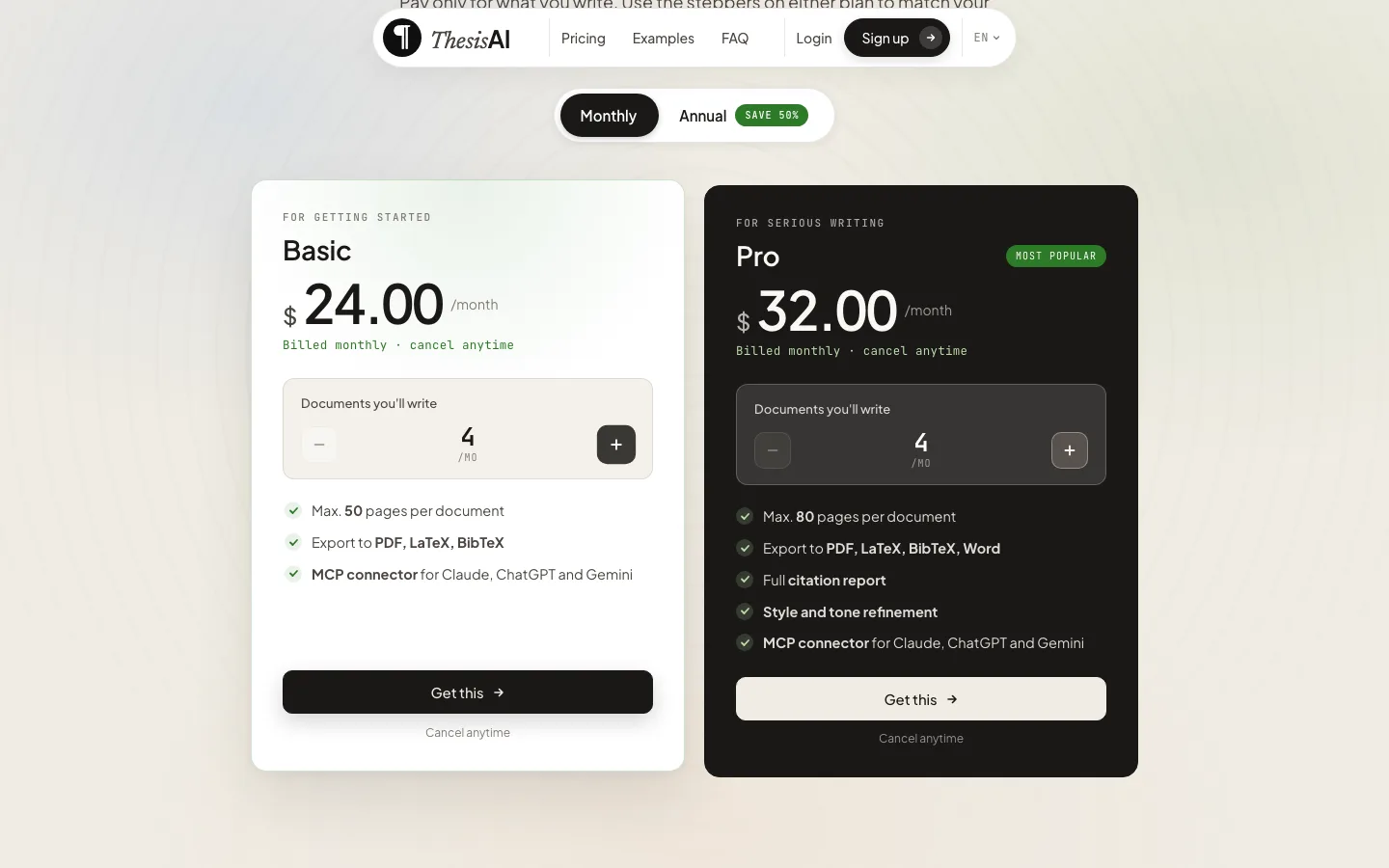
With monthly billing, as in the screenshot, Basic costs $24 a month for 4 documents of up to 50 pages each. Pro costs $32 a month, raises the cap to 80 pages, and adds Word export and a full citation report.
Billed yearly, the same plans cost $12 and $16 a month ($144 and $192 a year). There is no free plan. A paid trial gives one document of up to 15 pages for 72 hours. Payments are non-refundable except where the law requires.
ThesisAI is open about the risk. Its FAQ says handing in its output "is between you and your institution." It asks you to disclose AI use and check every citation. It adds that its terms "prohibit passing AI-generated output off as unaided human writing."
Trustpilot, the third result for this search, gave ThesisAI a TrustScore of 3.2 from 16 reviews on 7 November 2026. Over half of those reviews (56%) were one-star.
Complaints centered on recurring charges, weak or invented citations and ignored instructions. Trustpilot does not verify reviews, and the company disputes some of them.
3. Jenni: write it yourself, faster
Jenni is a writing editor that suggests your next sentence, with a citation, as you type. You can upload PDFs, import from Zotero or Mendeley, search more than 200 million papers and chat with your library.
Jenni links a sentence to its place in the PDF so you can check it. It exports to Word, LaTeX and HTML. Its thesis page is blunt about authorship. "Can AI write my dissertation? No, and you shouldn't want it to," it says. "You stay the author."
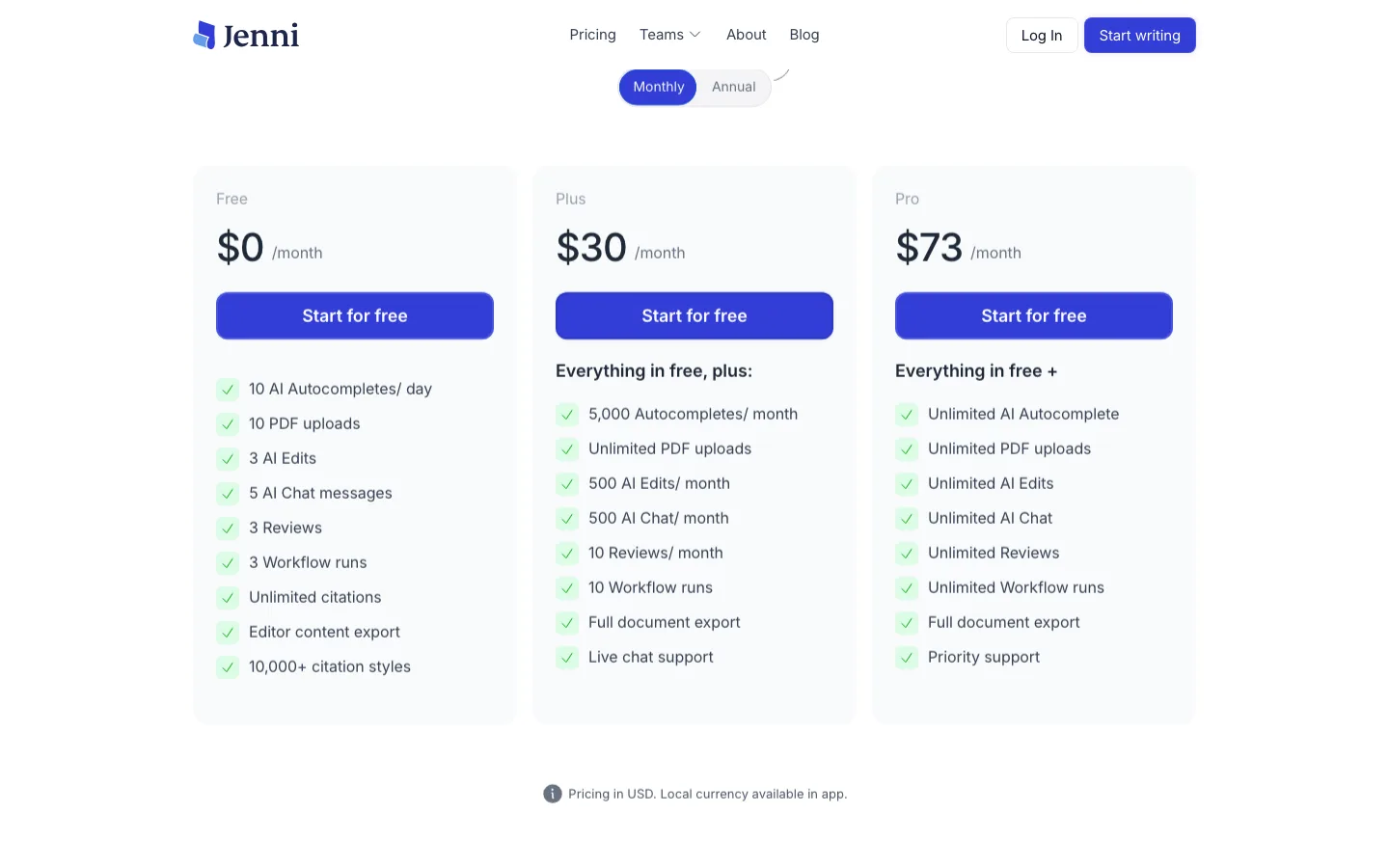
Billed monthly, as in the screenshot, Plus is $30 and Pro is $73. Billed yearly, which is the default view, they drop to $12 and $29 a month.
The free plan gives 10 autocompletes a day, 10 PDF uploads, 3 AI edits and 5 AI chat messages, with unlimited citations. For drafting in your own words with help on each sentence, Jenni is the strongest pick here.
4. Paperpal: editing and submission checks
Paperpal is an academic writing assistant aimed at students, theses included. It checks language and grammar and finds references for your claims across more than 250 million articles. It also has an AI writing tool that turns your ideas into drafts, which falls under the same rules as any AI-written text.
It supports over 10,000 citation styles and runs plagiarism checks against more than 99 billion webpages. It also has an AI detector, which deserves the caution in the integrity section below.
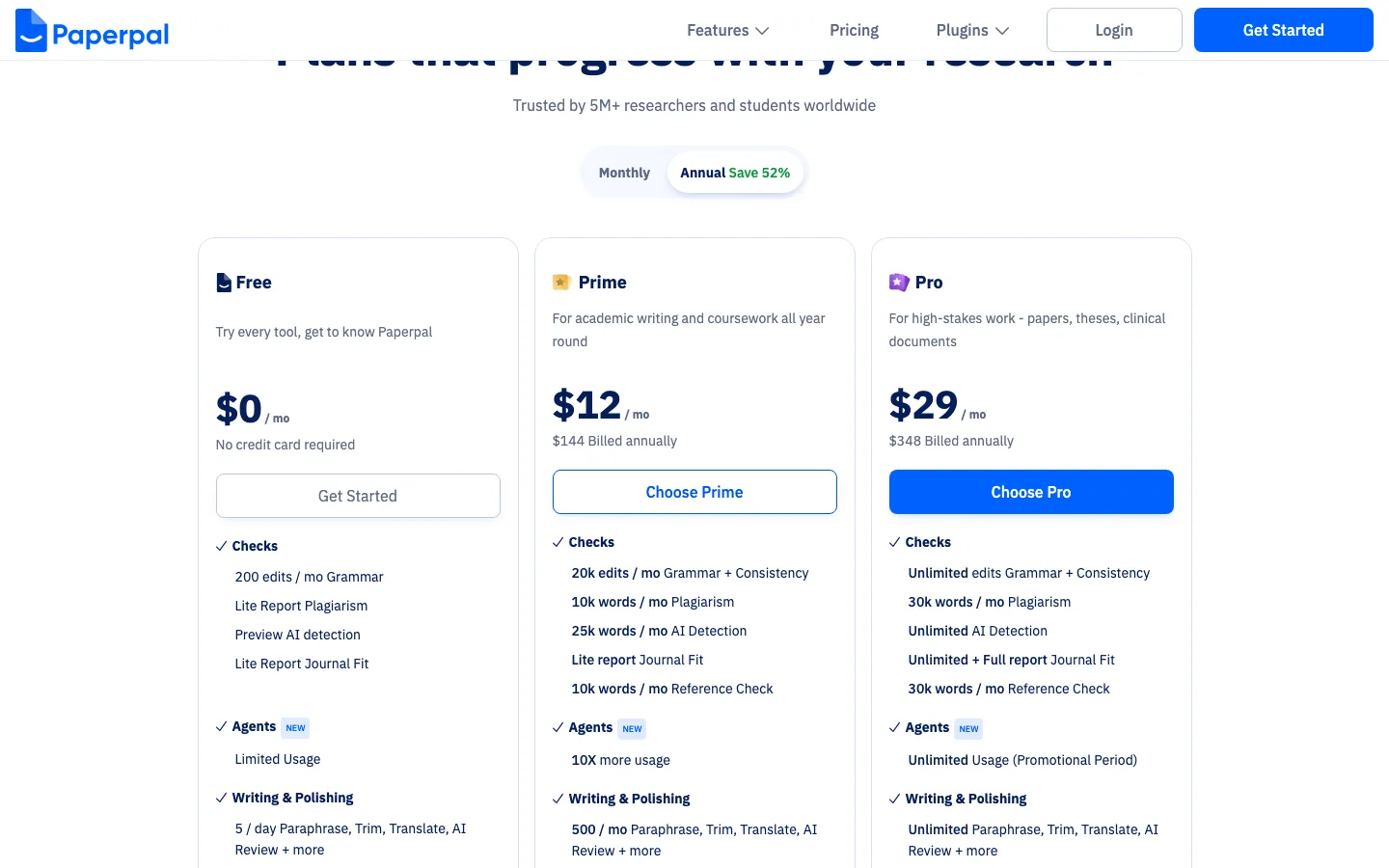
The screenshot shows yearly billing, with Prime at $12 a month ($144 a year) and Pro at $29 a month ($348 a year). Billed monthly, Prime is $25 and Pro is $59. Paperpal pitches Pro "for high-stakes work - papers, theses."
The free plan includes a lite plagiarism report, a preview of AI detection and 200 grammar edits each month. Paperpal is the pick for the final pass on a chapter you wrote.
5. GoThesis: planning tools on credits
GoThesis bundles small tools for each stage of a thesis. They cover outlines, proposals, hypotheses, a chapter guide, writing blocks, literature research, source summaries, citation formatting, plagiarism checks and AI detection. Some tools run without an account.
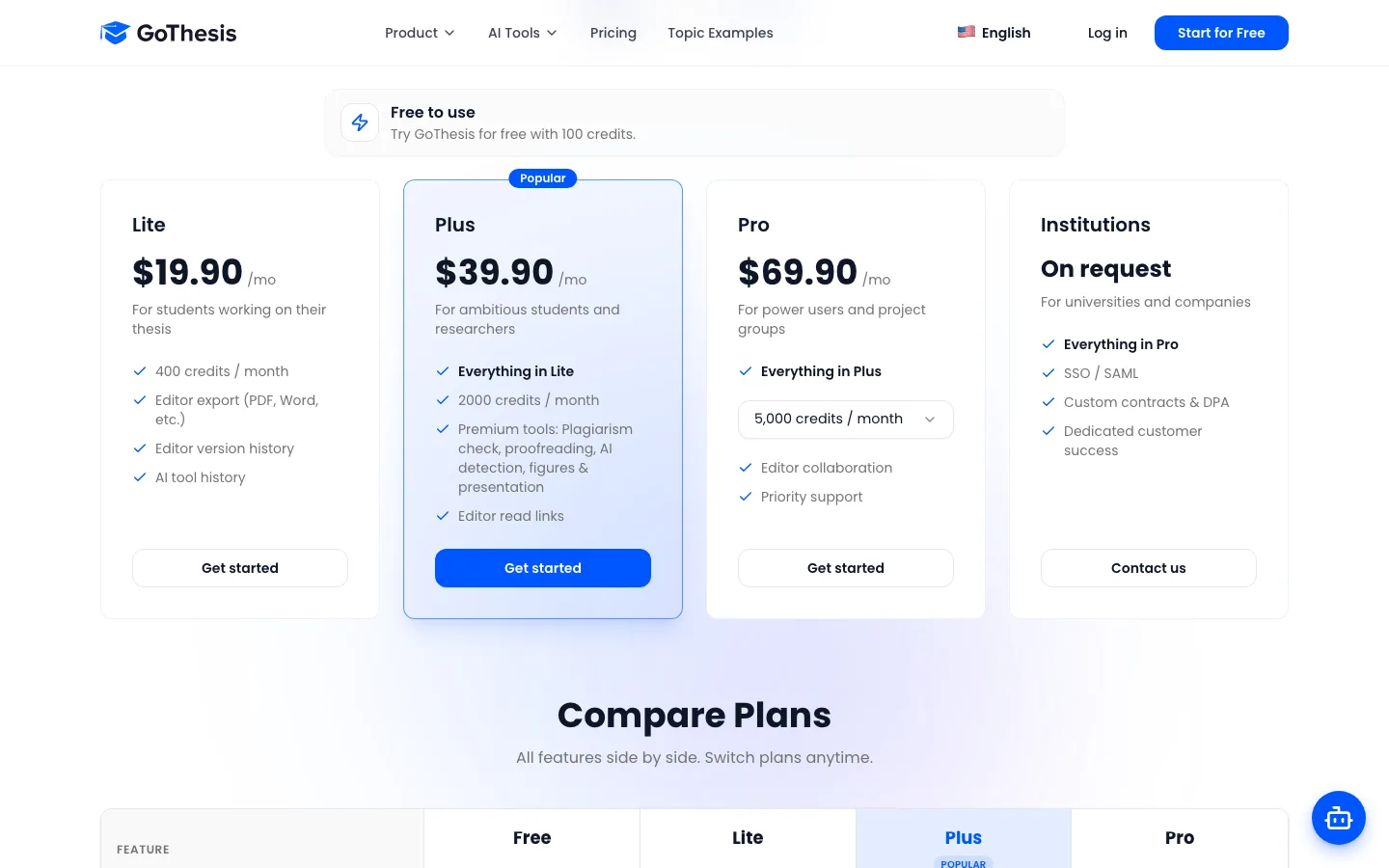
The screenshot shows the monthly credit plans. Lite is $19.90 a month for 400 credits, Plus $39.90 for 2,000 and Pro $69.90 for 5,000. Yearly plans cost $199, $399 and $699, and the free plan gives 100 credits.
GoThesis suits early planning, such as testing an outline or a proposal structure. Its writing blocks generate text, so the same rules apply as for any thesis generator.
Atlas test: 4 papers, one question
To see whether page citations hold up, I ran one thesis-style question in Atlas on 7 November 2026. I used a QA account on the Free plan and 4 open-access papers on AI-text detection.
- Liang and colleagues (2023), GPT detectors are biased against non-native English writers
- Weber-Wulff and colleagues (2023), Testing of detection tools for AI-generated text
- Perkins and colleagues (2024), The AI Assessment Scale
- Sadasivan and colleagues (2023), Can AI-generated text be reliably detected?
I asked the kind of question you might ask while drafting a literature review chapter.
I'm writing the literature review chapter of my thesis on AI-text detection in university assessment. Using only these four papers: how reliable are AI-text detectors, who do they misjudge, and what do the authors recommend instead of relying on detectors? Cite each claim with its page.
The answer took about 107 seconds and drew on all 4 papers. It carried 36 citations, each labeled with the file and page. Selecting a citation opened the PDF at that page with the passage highlighted.
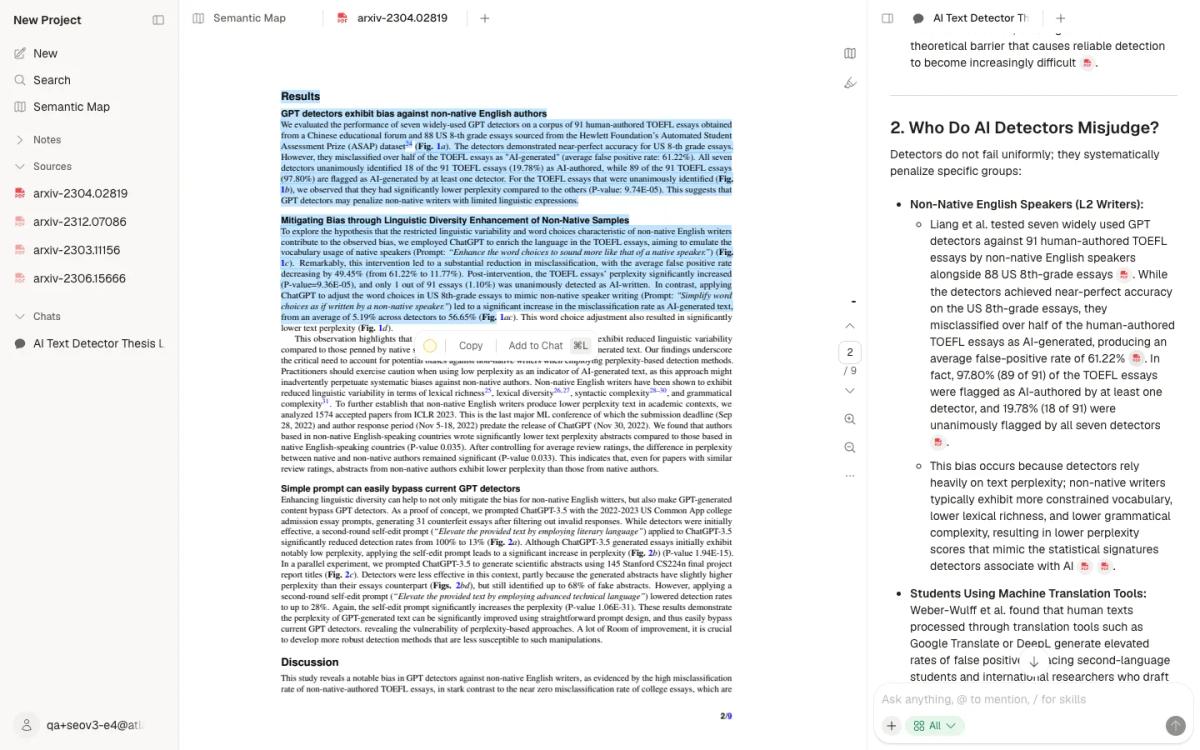
The screenshot shows page 2 of 9 of the Liang paper open beside the answer, with the cited sentence highlighted.
I then checked 16 specific numbers and recommendations against the text of the cited pages. Of those 16, 15 were on the page cited.
The miss was one sentence about oral viva-voce exams, cited to two papers. The phrase is on page 8 of Perkins and colleagues but is absent from the Weber-Wulff page cited beside it. My check covered 16 of the 36 citations. A slip like that one only shows up when you open the page.
The integrity risk of thesis-writing AI
A tool that writes thesis text for you carries three risks.
The first is your rules. Universities, departments and supervisors set their own AI rules, and many do not let you submit text an AI wrote. Some allow editing help if you keep your own version.
The AI Assessment Scale describes one such level. "AI can be used, but your original work with no AI content must be provided in an appendix," it says (page 7). Ask your supervisor what applies, in writing, before you use any drafting tool.
The second risk is that detectors will not settle the question either way. Weber-Wulff and colleagues tested 14 detection tools and found all of them below 80% accuracy, with only 5 above 70% (page 28). They warn that machine translation can raise false positives for second-language students (page 29).
Liang and colleagues ran seven detectors on 91 TOEFL essays written by people. The detectors were near perfect on US eighth-grade essays. Yet they flagged over half the TOEFL essays as AI-written, a 61.22% average false positive rate (page 2).
In the other direction, Sadasivan and colleagues cut a watermark detector's catch rate from 99.3% to 9.7% by repeatedly paraphrasing the AI text (page 3). A detector cannot prove your writing is yours. Passing one does not make generated text allowed either.
The third risk is wrong citations. Walters and Wilder (2023) checked 636 citations in short literature reviews written by ChatGPT. They found 55% of GPT-3.5's citations and 18% of GPT-4's were fabricated.
Tools that cite your own uploads can still attach a claim to the wrong page, as the one miss in the Atlas test shows. Open every cited page before a claim goes into your thesis. A routine like the one in how to check AI citations helps.
Which thesis AI should you pick?
Start from your university's rules, then pick by the job in front of you. One tool rarely covers reading, drafting and checking.
- If you must write every word yourself, read and cite in Atlas, write in your own editor, and run Paperpal's checks before you submit. Jenni's autocomplete also suggests text, so check that your rules allow it.
- If your rules allow AI drafting with disclosure, ThesisAI is the most complete drafting tool here. Disclose it, and check every citation against the source.
- If you are early and still planning, GoThesis's outline and proposal tools are a cheap start.
- If you have a pile of PDFs and no synthesis yet, start in Atlas. Ask where the papers agree and disagree, then sort the answers by theme in a synthesis matrix.
For a step-by-step workflow that keeps you inside your rules, see AI for thesis writing, and for UK, Irish and Australian dissertation rules, see AI for dissertation writing. For a wider set of research tools, see the best AI research assistants. To compare chatbots that attach sources, see AI with references. For reading single papers, see academic paper AI, and for formatting references, see citation tools for research.
Cite your thesis sources by page
Upload papers, ask one chapter question, and open the page behind each claim.