
Affinity Mapping: Turn Research Notes Into a Workshop Map
Affinity mapping for UX research, with a worked observation table: prepare source-linked notes, group them, handle outliers, and name clusters together.
- Byline

Summary
Affinity mapping groups individual observations or ideas by perceived similarity, then names and reviews the clusters with a team.
Put one observation on each note. Keep a source marker so the team can check the full account before placing it.
Treat each cluster as a first guess. Recheck odd cards and agree on the next step with the team.
Affinity mapping is a way to put related observations or ideas next to each other. A team then discusses and names the groups. In UX research, each card might capture one thing a person said or did. The team moves cards on a wall or shared board to find links worth checking.
Suppose an interview note says, “I set a reminder because my plan disappears under other tabs.” A short card could read “plan gets lost while switching tabs.” Keep the interview and time marker with it.
Before grouping that card with other reminder notes, reopen the passage. Was the problem forgetting, finding the plan, or juggling tasks? The answer can change where the card belongs.
Atlas can help prepare selected research records into a cited observation table. You still inspect each source and run the visual sorting with your team. The map's labels and decisions belong to the people who understand the study.
Atlas

Prepare source-linked observations in Atlas
Check cited observations before your team sorts them.
What affinity mapping means
An affinity map, or affinity diagram, is a set of cards arranged by perceived relationship. Each card is a small unit. A cluster is a group the team sees after moving the cards. Nielsen Norman Group's UX guide describes three phases: make notes, group them, and decide what to do next.
The method can sort study notes, early design ideas, or brainstorm output. Say what kind of card you have. A person's account of a failed checkout comes from a study. “Add a save button” is the team's own proposal.
Mark that difference on the board. Otherwise, a proposed fix may look like a user finding. If you need a fuller process for assigning first-pass labels to source text, use the qualitative coding guide.
An affinity map helps a group see how small points may relate. It can also reveal a card that refuses to fit the first story. A lone researcher can make a map; a team session gives more people a chance to challenge card placement and wording. The research report must still explain what the groups mean and why.
Prepare one observation per card
Start with a question that guides which notes to include: “Where does planning a study session break down?” Gather the relevant interview and test records. Read the full passage before cutting it down to card length.
Write one observation per card. If someone cannot find a saved plan and also gets a reminder too late, make two cards. A team may agree about the search problem while seeing the reminder in another group.
The ASQ affinity method begins with one idea on each card. The User Interviews guide makes the same point for research notes. This makes each card easy to move.
For research cards, keep a compact provenance trail:
- Card text: one plain observation. Keep causes and fixes in separate notes.
- Source ID and locator: the interview, participant alias, timestamp, page, or line that lets an authorized researcher reopen it.
- Evidence type: direct quote, observed action, or the researcher's paraphrase.
- Context note: enough to prevent a clipped sentence from changing meaning.
The UXPA method guide advises adding a user ID to cards drawn from study records. This lets the team find the person behind a note. Use aliases and follow the study's consent rules.
A board shared beyond the study team may need fewer personal details than the private source record.
Do not start with polished cluster labels. A preset “notification problem” heading can pull a search difficulty under it before anyone has compared the cards. Keep tentative ideas available, but let the cards and the workshop conversation test them.
Sort notes before naming groups
Place the cards where all team members can read and move them. Use a wall or a shared board. The NN/g workshop guide puts grouping before labels and asks teams to keep small or odd groups in view.
Ask the group to move cards toward others about the same snag, action, or setting. Start with the card text and its source. Let the first round move quickly. A vote over every card would stop the team from trying out links.
The ASQ process lets people move cards again and leaves room for those that do not fit.
Once movement slows, read each group aloud. Can one sentence name what its cards share? If the only shared word is “app,” the label is too broad.
If half the cards concern finding a saved plan and half concern choosing when to study, split the group. You can copy a disputed card into two groups for discussion. Mark the copy as a trial placement.
End the session by recording what the groups suggest and what remains uncertain. A cluster of complaints may warrant a focused usability test; it does not automatically become a product priority. The team should keep the board and a short rationale for major moves so later readers can see why its labels changed.
Work through an affinity map example
The following six cards are fictional. They show how a team might prepare for a study of how students plan study time. The IDs and time markers are made up. These cards came from no real study or Atlas result.
The table shows possible placements a researcher might bring into a workshop. It is not the final affinity map. The team should still move, rename, or reject these placements after checking the full records.
| Card and short observation | Fictional source locator | Possible placement to test |
|---|---|---|
| A. Saved plan is hard to find after closing the app. | Interview P1, 04:12 | Finding the plan |
| B. Several browser tabs hide the planning page. | Interview P2, 08:36 | Finding the plan |
| C. A reminder appears after the student has started work. | Interview P3, 11:07 | Timing the plan |
| D. The student writes the plan on paper to keep it visible. | Observation P4, 02:19 | Finding the plan, or a separate workaround |
| E. The student changes tasks when a friend asks for help. | Interview P5, 06:44 | Ungrouped: social interruption |
| F. The student checks the plan by opening a pinned tab. | Interview P6, 09:03 | Ambiguous: finding the plan or successful workaround |
Table 1: This sample table keeps each card beside its source marker and possible group. The uncertain cards remain open for the team to discuss on the board.
The first two cards point toward trouble returning to a plan. Card C is about timing. Card D may be a way to keep the plan in sight. Card E stays outside the early piles.
A one-card group may still matter. Its small size should prompt a source check, not deletion.
Now reopen the full made-up P6 passage. Suppose the person says, “I pinned the plan tab after losing it twice.” Card F may belong with A and B because the pin solved an access problem.
If the person says, “I always keep that tab pinned; finding the plan is easy,” Card F may challenge that group. The short card alone cannot settle the question.
Check outliers and revise clusters
This is the evidence check. Imagine the team first names the A/B/D/F pile “people forget their plans.” The cards do not support that claim. P1 may remember the plan but struggle to reopen it. P4 may write on paper to keep the plan in sight.
After reading those sources again, the team changes the label to “keeping a plan available during work.”
The new label shifts the next question. The team can watch how students return to a plan while switching tasks. It can leave Card C in a timing pile and Card E ungrouped. A later source or test may shed light on social interruption.
Write down the source check and the choice that followed:
- Original placement: A, B, D, and F looked related because each mentioned a plan.
- Source check: A and B describe access trouble; D is a possible workaround; F needs context before its role is clear.
- Revised label: “Keeping a plan available during work” is narrower than “people forget.”
- Open question: Does the paper note solve an access problem or serve a different purpose?
- Next step: Review the full P4 and P6 accounts, then test the label against another session.
This is where affinity mapping connects to inductive thematic analysis. A group on the board may suggest a line of inquiry. A research theme needs a clear account of what the pattern means for the study question. The team must still do that work.
Prepare traceable notes with Atlas
Atlas can help before and after the board session. Put permitted study records in one project. Mention the sources you want to check in chat. Ask for one point per row about finding or using a study plan, with a citation, short card text, and a flag for cards that might fit two groups.
Treat the response as a draft card list. Open each citation and read the source around it. Delete weak rows, split cards that pack two points together, and revise labels that assume a cause. Look for missed records. The team will build its own map and judge what each source supports.
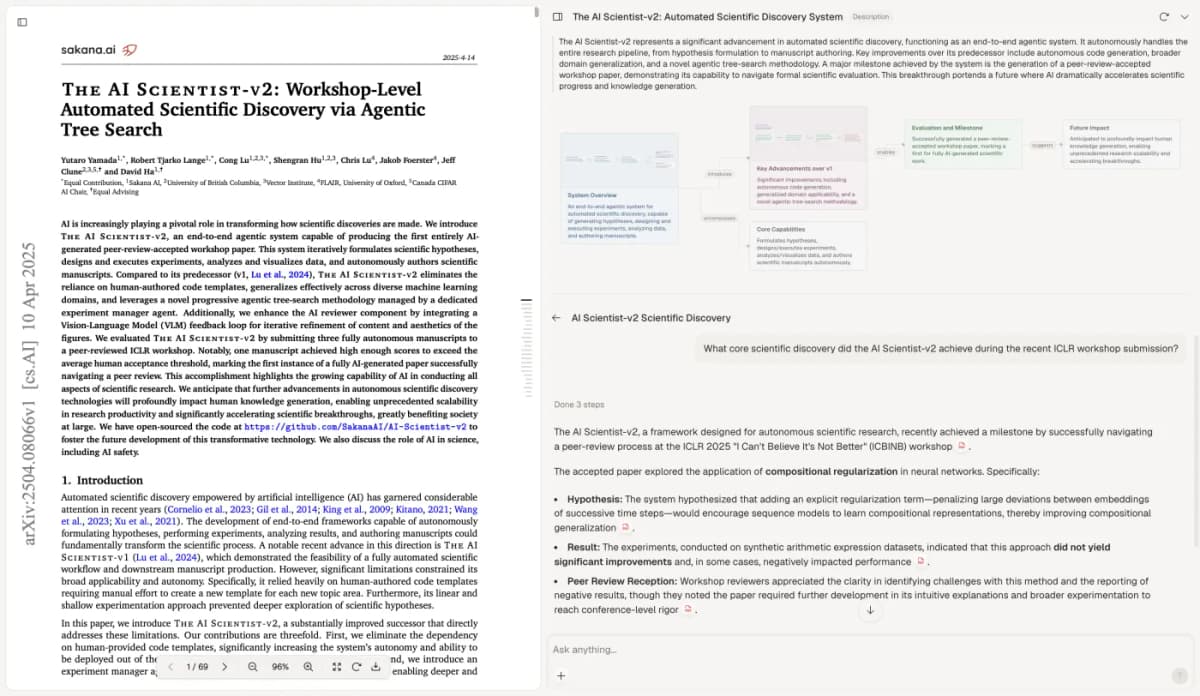
This first-party Atlas screenshot shows an answer beside an open paper about AI science. It shows where to inspect a cited answer. The student study and its affinity cards are fictional.
Save checked cards and later group choices in notes. Keep a source link, a disputed placement, and the next question near each decision. Build the spatial map in your team's workshop space. If you need a shared canvas, Miro alternatives can help you choose one. The Atlas and Miro comparison explains the source-work versus board-work split.
Know what the map cannot prove
An affinity map shows how the team grouped its notes. Its shape cannot tell you how common a problem is. Six cards from one person still represent one person.
A large pile may reflect what the team chose to collect or how it split the notes. Keep source markers close enough to check that difference.
Grouping cannot show cause. Cards about late reminders and lost plans may sit together. The board cannot tell whether one led to the other.
Use the group to choose what to inspect or test next. Return to full records, seek a counterexample, and state the study's limits in any report.
If the group leads to a new workshop step, run an after action review after the next session. Compare the plan with what happened, then record only the changes the team agreed to test.
The exercise works when people can disagree about a card and revise the map. NN/g advises against forcing notes into clusters and treats outliers as worth a look.
Keep a card that does not fit. Say what remains unclear and who will check it. A traceable choice will help the team more than a tidy board.
Atlas
Prepare source-linked observations in Atlas
Check cited observations before your team sorts them.
Frequently Asked Questions
It is a collaborative way to place individual observations or ideas near related ones, then label and discuss the resulting groups. A source-linked research note lets the team check context.